
At 21, Stephen Hawking received a diagnosis that would have broken most people. Doctors told him he had amyotrophic lateral sclerosis (ALS, also called motor neuron disease), a progressive condition that destroys the nerves controlling voluntary muscles. The prognosis was grim: most people survive only 2 to 5 years after diagnosis. Hawking was given about two years to live.
He lived another 55 years
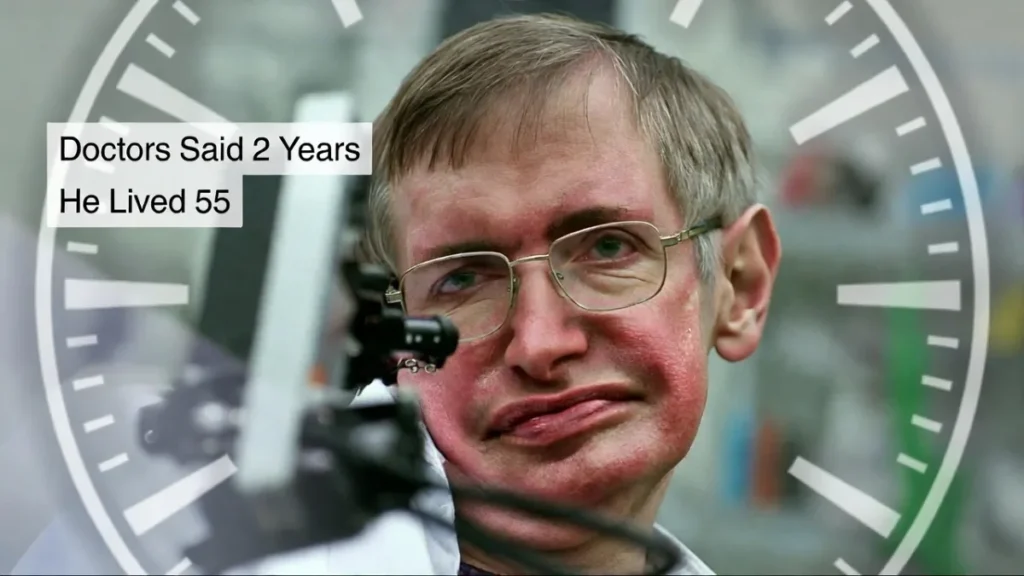
Until his death in March 2018 at age 76, Hawking remained one of the world’s most brilliant physicists, wrote bestselling books, raised a family, traveled the globe giving lectures, and became a global symbol of what the human spirit can achieve against overwhelming odds. German medical literature has frequently examined his case as one of the most exceptional long-term survivals ever recorded with ALS. His story isn’t just inspirational – it’s a genuine medical puzzle that continues to challenge what we think we know about the disease.
Also Read



The Diagnosis and Early Years
Hawking was a young Cambridge graduate student when he first noticed he was becoming unusually clumsy. He fell down stairs, dropped things, and struggled with small movements. After a series of tests, the diagnosis came: ALS. The disease attacks the motor neurons in the brain and spinal cord, leading to muscle weakness, paralysis, difficulty speaking, swallowing, and eventually breathing. The mind usually remains completely intact.
In the early 1960s, when Hawking was diagnosed, ALS was considered almost invariably fatal within a few years. Yet something about his particular form of the disease was different. The progression was extraordinarily slow.
Within a few years he needed a wheelchair. By the late 1960s and early 1970s his speech had become slurred and hard to understand. In 1985, a severe pneumonia forced an emergency tracheotomy, after which he lost his natural voice entirely. From that point forward he communicated using a speech-generating computer controlled first by hand movements, then by a single cheek muscle, and later by eye-tracking technology.
Despite these profound physical limitations, his scientific productivity never stopped. He published major papers on black holes, cosmology, and quantum gravity, wrote A Brief History of Time (which sold over 10 million copies), and continued working almost until the day he died.
Why Did Hawking Live So Much Longer Than Expected?
ALS is not a single disease but a syndrome with multiple subtypes and causes. Most cases progress relatively quickly, but a small percentage – perhaps 5–10% – follow a much slower course. Hawking fell into an extremely rare subgroup often described as “chronic-juvenile” or very slowly progressive ALS.
Several factors likely played a role in his exceptional survival:
- Very young age at onset — Being diagnosed in his early 20s is uncommon. ALS usually appears after age 50. Younger-onset cases sometimes progress more slowly, possibly due to differences in underlying biology or how the disease interacts with a younger nervous system.
- A biologically milder form — In some people the disease advances in fits and starts or even seems to plateau after initial decline. Hawking’s neurologists described his variant as having unusually slow progression from the beginning.
- Outstanding medical and nursing care — As a world-famous scientist, he had 24-hour professional nursing support, the best available respiratory equipment, feeding tubes when needed, and constant monitoring to prevent infections. While excellent care can extend life, it rarely explains survival over five decades on its own.
- Genetic and individual differences — More than 20 genes are now linked to ALS. Certain mutations are associated with slower progression. Hawking’s extreme longevity remains one of the longest documented cases, even among other known long-survivors.
Later predictive models (such as the ENCALS survival tool) retrospectively estimated that Hawking had a very high probability of living many years beyond average expectations, highlighting how atypical his disease course truly was.
A Life Full of Achievement and Joy
Hawking often said his disability gave him more time to think. Free from routine teaching duties and administrative work, he could focus intensely on theoretical physics. He married twice, had three children (Robert, Lucy, and Timothy), maintained a sharp sense of humor, and engaged with the world in ways few healthy people do.
He appeared on television shows like The Simpsons and Star Trek, narrated documentaries, flew in zero gravity, and gave lectures worldwide using his iconic speech synthesizer. He described his life as happy and fulfilled, once writing that he had been “lucky” despite everything.
What His Case Means for ALS Research and Patients
Hawking’s 55-year survival doesn’t change the harsh reality for the majority of people with ALS, where life expectancy remains short and quality of life is often severely affected. But his case offers real hope and important scientific lessons:
- It proves that extreme variability exists in the disease.
- It shows that early-onset, slowly progressive forms can allow decades of productive life.
- It underscores the value of intensive supportive care (respiratory support, nutrition, infection prevention) in extending survival.
- It continues to drive research into why some cases are so much milder, which may one day lead to new treatments.
Stephen Hawking didn’t beat ALS – he lived brilliantly with it for longer than almost anyone thought possible. His mind remained one of the sharpest on the planet while his body gradually failed, yet he never let the disease define him.
His legacy is both scientific and deeply human: proof that courage, curiosity, humor, and love can coexist with even the most severe physical limitations.
What part of Hawking’s story moves you most – his scientific breakthroughs, his refusal to be defined by illness, or the sheer length of time he defied the odds? I’d love to hear your thoughts.





 Important Notice -The content on this website is provided for general informational and educational purposes only. It is not a substitute for professional medical advice, diagnosis, or treatment. Always consult a qualified healthcare provider before making any health-related decisions.