
You’ve probably heard it a thousand times: in a “normal” 28-day menstrual cycle, ovulation happens right around day 14. That’s the classic rule taught in school sex ed classes, printed in countless fertility books, and baked into many period-tracking apps. It’s simple, memorable, and… mostly wrong for the majority of women.
A large-scale study from 2019, analyzed in detail by the German medical journal Deutsches Ärzteblatt, turned this long-held assumption on its head. Using real-world data from over 600,000 menstrual cycles tracked by more than 124,000 women, researchers showed that ovulation timing is far more variable than the textbooks suggest. The idea of a fixed day-14 ovulation is outdated – and understanding the reality can make a big difference for anyone trying to conceive, avoid pregnancy, or simply better understand their own body.
Also Read



The Classic Assumption vs. Real-World Data
The traditional model assumes a textbook 28-day cycle with ovulation exactly 14 days before the next period starts. That would place ovulation on day 14 if day 1 is the first day of bleeding. The fertile window – the days when pregnancy is possible – would then be roughly days 10–16.
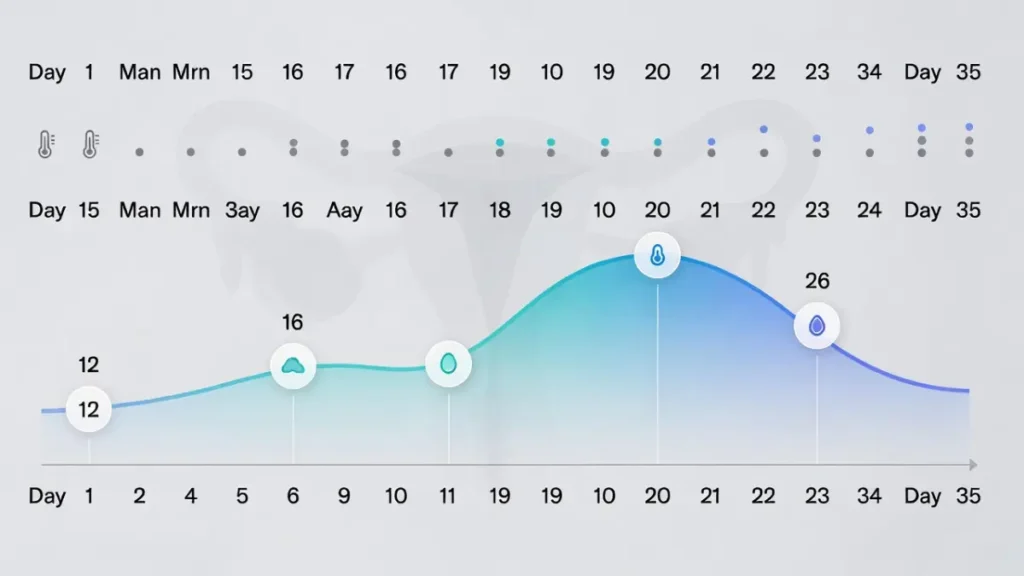
But here’s what the big study found:
- Only 13% of women actually have a 28-day cycle.
- The average cycle length is 29.3 days.
- About 65% of cycles fall between 25 and 30 days (still a broad range).
- The follicular phase (the time from the start of your period to ovulation) averages 16.9 days, with a wide normal range of 10–30 days.
- The luteal phase (from ovulation to the next period) is more stable, averaging 12.4 days (normal range 7–17 days).
In other words, for the average woman with a 29.3-day cycle, ovulation more often happens around day 17, not day 14. And for many, it’s much earlier or much later depending on cycle length.
Break it down by cycle types:
- Shorter cycles (21–24 days): Follicular phase averages 12.4 days → ovulation around day 12–13.
- Typical cycles (25–30 days): Follicular phase around 15.2 days → ovulation closer to day 15–16.
- Longer normal cycles (31–35 days): Follicular phase about 19.5 days → ovulation around day 19–20.
- Very short cycles (15–20 days, about 18% of all cycles): Ovulation as early as day 10–11.
- Very long cycles (36–50 days): Ovulation can be delayed to day 26–27 or later.
This variability means the fertile window can shift dramatically from one woman to another – and even from cycle to cycle in the same woman.
Why Does Ovulation Timing Vary So Much?
The main driver is the follicular phase. The luteal phase stays relatively consistent for most women, so differences in overall cycle length come almost entirely from how long it takes the follicle to mature and release the egg.
Other factors play a role too:
- Age: From age 25 to 45, average cycle length shortens by about 0.18 days per year (roughly 3–4 days total over 20 years), mostly because the follicular phase gets shorter.
- Body weight: Obese women (BMI >35) show more cycle-to-cycle variation. Underweight women (BMI 15–18.5) tend to have slightly longer periods.
- Individual biology, stress, illness, travel, exercise, and other lifestyle factors can also shift ovulation in any given month.
What This Means for Fertility Awareness and Conception
If you’re trying to get pregnant, timing intercourse around day 14 alone can easily miss the fertile window. Apps or calendars that rely only on cycle length predictions often get it wrong – sometimes completely.
Experts in the study emphasized that accurate identification of the fertile period requires more than just counting days. Tracking additional signs – like basal body temperature (BBT), cervical mucus changes, or using ovulation predictor kits – gives a much clearer picture.
One of the researchers, Joyce Harper from UCL’s Institute for Women’s Health, put it plainly: “To identify the fertile period, it is important to measure other parameters such as basal temperature. Analysis of cycle data alone is not meaningful.”
Even for natural contraception, the old calendar method (avoiding days around 14) is unreliable because ovulation can happen days earlier or later.
Busting the Myth in Everyday Life
The day-14 rule came from early 20th-century observations of “normal” cycles, but real women aren’t averages. Modern big-data studies from fertility apps have given us a clearer, more honest picture: menstrual cycles are highly individual.
If your cycles are regular but not exactly 28 days, or if they vary by a few days month to month, your ovulation is almost certainly not locked to day 14. Recognizing this can reduce frustration when trying to conceive – and help explain why some couples struggle despite “perfect” timing.
Bottom line: Listen to your body, track more than just cycle length, and don’t trust the old textbook rule blindly. Ovulation is personal, variable, and rarely as predictable as day 14.
Have you ever noticed your ovulation didn’t line up with the classic day-14 expectation? Or has this myth affected your planning? Share your experiences below – it’s fascinating how different everyone’s cycle really is.




 Important Notice -The content on this website is provided for general informational and educational purposes only. It is not a substitute for professional medical advice, diagnosis, or treatment. Always consult a qualified healthcare provider before making any health-related decisions.